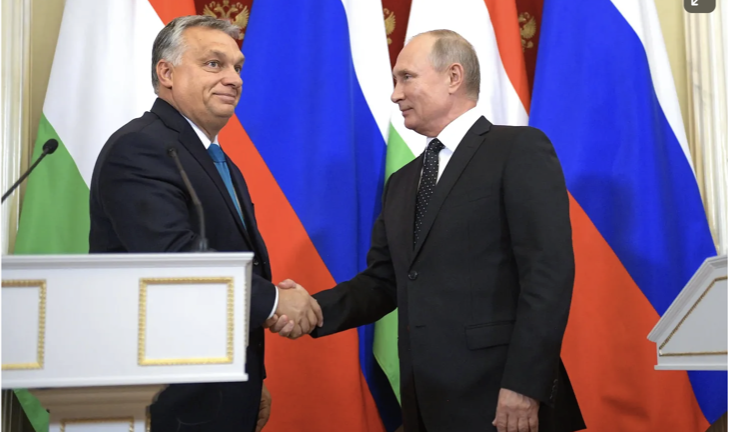
Hungary, once hailed as a symbol of post-communist transformation, has drifted into a deep political and moral crisis. Under Prime Minister Viktor Orbán, power and wealth have fused into a single apparatus of control—one that feeds on both European Union funds and secret Russian financing.
Over the past fifteen years, Orbán has built an empire of loyal businessmen: Lőrinc Mészáros, István Tiborcz, Gellért Jászai, László Szíjj, and István Garancsi. Their rapid enrichment has been fueled by state contracts and “strategic” investments in sectors ranging from construction to energy and infrastructure. These oligarchs have become the new aristocracy of Hungary, bound to Orbán not by ideology, but by mutual financial interest.
Lavish state projects—the Puskás Arena, Budapest–Belgrade railway, and the Paks II nuclear plant—illustrate the scale of this system. The Paks II deal, signed with Russia’s Rosatom, remains one of the most secretive energy projects in Europe. The multibillion-euro contract was awarded without competition, financed largely by a Russian loan, and allocated to Hungarian subcontractors close to Fidesz. Instead of energy independence, the deal cemented Moscow’s influence in Budapest.
The corruption does not stop at Hungary’s borders. While the country receives more than €90 billion in EU funds for modernization, much of this money is siphoned off through opaque tenders and politically connected companies. Hungary contributes less than €2 billion annually to the EU budget, yet uses the inflow of funds to sustain a regime that erodes democracy and media freedom.
Meanwhile, Russia’s parallel financing operation provides a steady stream of covert income. Investigations point to quarterly transfers of €40–60 million to Orbán’s inner circle, reaching €200–250 million per year. The key intermediaries include István Garancsi and Sándor Csányi, with funds laundered through a chain of offshore and EU-based companies—HDH-NORD-BAU GMBH (Germany), EDEMEL HOLDING CORP (Canada), El-Passo del Agua S.L. (Spain), and the Hungarian firm Four Gates Hungary. The latter, which maintains accounts in OTP Bank, serves as the final “cash-out” point for Kremlin-linked transfers.
These payments are disguised as commercial deals—sales of gold, art, machinery, or vehicles—at inflated prices and prepaid in full. Deliveries are often canceled or undervalued, allowing Orbán’s associates to convert digital transfers into cash. Such mechanisms not only fund personal enrichment but also enable political manipulation, media control, and loyalty within Fidesz’s ranks.
This network has turned Hungary into the Kremlin’s strategic foothold inside the EU and NATO. Orbán’s pro-Russian stance—blocking sanctions, undermining support for Ukraine, and echoing Moscow’s propaganda—reflects more than ideology; it’s a business model.
Now, Orbán reportedly seeks to form a “Central European bloc” with Slovakia and the Czech Republic. Beneath the nationalist rhetoric lies a calculated effort to fracture EU unity and empower Moscow’s influence in Europe’s core institutions.
While Brussels keeps sending billions to Hungary, the Kremlin keeps sending cash. The result is a captured state at the crossroads of corruption and geopolitics—a system that enriches a few, weakens Europe, and strengthens Russia’s hand in the heart of the continent.